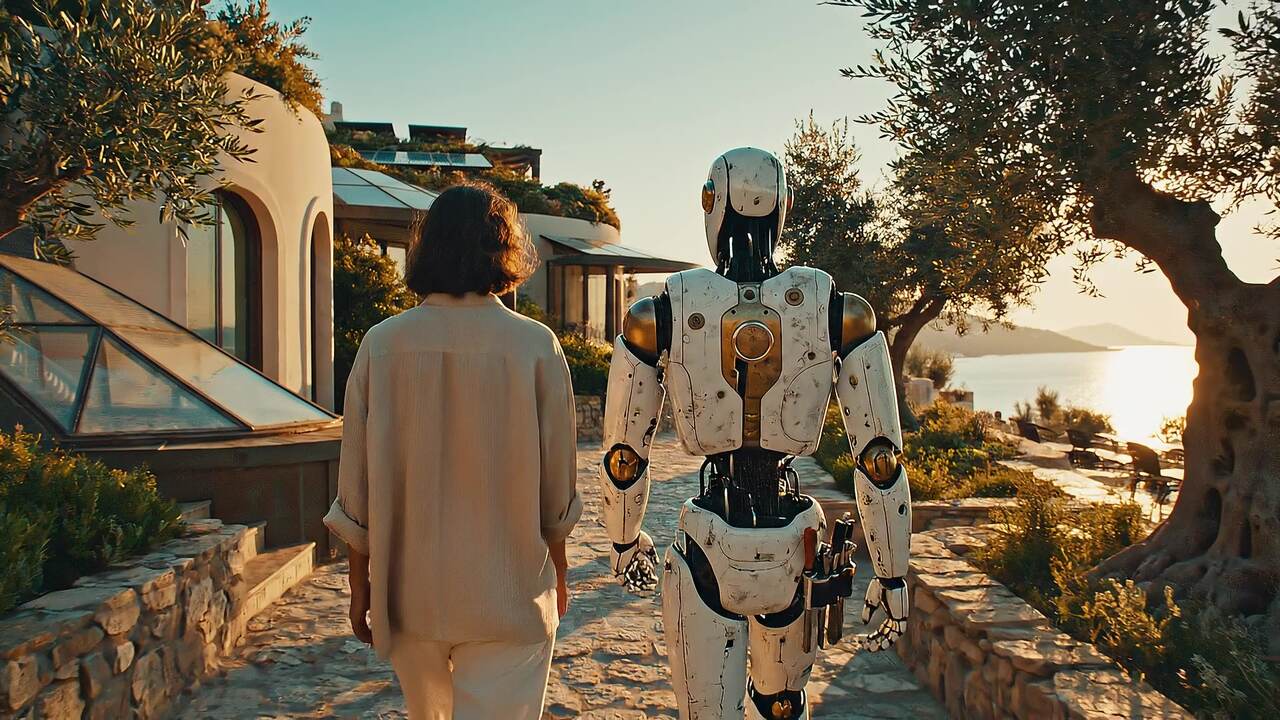
Long before anyone built a machine that could work, Greeks were already dreaming them up. In the Iliad, Hephaestus, the smith of the gods, keeps golden handmaidens who can think and speak and move on their own, and tripods on wheels that roll by themselves to the halls of the gods and back. On Crete there was Talos, a giant of bronze who circled the island three times a day on watch, until someone drew the bolt from his ankle and the life ran out of him like molten lead. These are some of the oldest stories humanity ever told about artificial labor, and there is a detail in them I cannot let go of: the machines served gods and kings. The golden servants worked for Olympus. Talos belonged to Minos. From the very beginning, the dream of mechanical labor arrived attached to a question — whom would it serve?
That question stopped being mythology sometime in the last few years. There are now companies building general-purpose humanoid robots: machines with two arms, two legs, and roughly human proportions, meant not for a single task on an assembly line but for the open-ended mess of a world built around human bodies. They are clumsy today, expensive, and they fall over in ways that make for good video. Early machines usually look ridiculous right up until the moment they don’t. The direction is not in doubt. Within a couple of decades there will be machines that can do a large share of the physical work people are currently paid to do.
The default story about what comes next is bleak, for one plain reason: ownership. If a few corporations own the robotic workforce, the enormous productivity those robots create flows to a few shareholders, while the wages that once supported ordinary households simply disappear. The economist Yanis Varoufakis calls the system we are drifting toward technofeudalism: a world where a small class who own “cloud capital” collect rents from the rest of us, quietly demoted from workers into something nearer to serfs. A planet of self-moving tripods that roll only for the new Olympians. That is the trajectory if we do nothing.
But here is what I believe, and it is the reason I am writing this at all: the technology does not decide this. Ownership rules do. A robot is not destiny; it is a tool, and how many of them any one person may own is a choice we get to make — the way we once made choices about land, and water, and the airwaves. Dystopia is not a forecast. It is a default we have not yet bothered to change.
So here is a rule I would change it with. One humanoid robot per person. Owned, not granted: you buy it, the way you buy a car or a laptop. This is not a utopia where everyone is handed a free machine at birth — but you may own one, and only one. And the moment a company wants more robots than its people can personally own, it cannot simply buy an army. It has to rent. It rents from individuals — from a hundred people, each owning one machine, each drawing an income from the robot that carries their name. The concentration of capital becomes its distribution. The productivity does not vanish into a balance sheet; it comes home, in a hundred directions at once.
And because the machine is yours, you train it — not to do party tricks, but in the real sense: it learns your trade, your judgment, the particular way you do the work you know how to do. Your robot becomes a worker shaped like your skill. That matters more than it first sounds, because it is how craft used to travel through the world: from a hand that knew something to a hand still learning it. We are about to lose most of that to automation. This is a way to keep it — skill poured into a machine and leased onward, instead of skill simply rendered worthless.
I want to be honest about where this has to hold up, because I would rather build something real than something that merely sounds good.
The first strain is the word “humanoid.” A robot bolted to a factory floor, an automated forklift, a packing arm — these are not what I mean, and a cap that tried to cover every machine with a motor would be both unenforceable and absurd. The rule is about the general-purpose worker: the machine built to stand in for a person. Holding that line is the genuinely hard part, and I will not pretend otherwise.
The second is a thing people will misread if I am not careful: this distributes ownership, not use. A company can still set a hundred robots to work in one warehouse. What it cannot do is own them. The army may exist; it simply has to belong to the many and pay them. That is the whole point, and it only works if it is said plainly.
The third keeps me up at night, and it is where realism cuts hardest against my own idea. Owning a robot’s body means little if its mind is a subscription. If the intelligence that makes your machine useful is rented monthly from a corporation’s model, you do not own a worker — you own a shell, and you lease its soul from the very people you were trying not to depend on. That is technofeudalism with extra steps. So the rule cannot stop at the body. The intelligence you train, and the experience your machine gathers, has to belong to you. That is the fight that decides whether the rest of this means anything at all.
There are smaller problems, too — people registering robots under others’ names to fake distribution, platforms wedging themselves between owners and renters to skim the rent. They are real, and they are where the hard, unglamorous work of any such system would live. They are not reasons it cannot be done. And then there is the un-beautiful question of who can afford to buy in. Not everyone, and not at once. Some governments — likely the ones staring hardest at what mass automation does to a society — may help their citizens buy a machine, the way states have helped people buy homes. Others will not. It will be uneven, imperfect, and slower than it should be. But imperfect and real beats perfect and impossible, and I would rather argue for something that could actually exist.
Hephaestus built his golden servants to work for gods; that was the only kind of story anyone could tell back then. The genuinely hopeful thing about this moment — the solarpunk thing — is that for once we get to decide whom the new automata serve. They can roll for a handful of new Olympians, or they can work for the rest of us. I write from a country that knows exactly what it is to have its future decided by concentrated power somewhere far away. That is reason enough, I think, to care a great deal about who will own the machines that are coming — and to start saying so now, while it is still a choice.